LNX
Linux — available now
High-fidelity music player with ALSA Direct (hw:, exact rate); Compat via plughw/default.
Public trial download live. Ubuntu, Debian, Fedora, Mint, Pop!_OS, and similar.

Looking for the best audio and music player on Linux? RenniLink Valve King is a ground-up high-fidelity music player — exclusive ALSA Direct to your DAC, physics-led valve colour, and Glorious Lossy — built for people who care how music lands in the room, not a soft-mixer skin.
The warmth, the harmonics, the feel of the analogue era — with modern exclusive playback that can stay honest to the file, then open living valve colour when you want the room to bloom.
RenniLink Valve King is not a skin on stock libraries. Decode, exclusive path, physics-led valves, and Glorious Lossy — built as one instrument for music that still feels played, not merely decoded.
Valve King is built first as a serious hi-fi music player for Linux — then the same engines for Windows. Same lifetime · 1 PC price — £79.99 limited-time (full price £129.99). A license for one machine/OS does not auto-unlock the other OS.
High-fidelity music player with ALSA Direct (hw:, exact rate); Compat via plughw/default.
Public trial download live. Ubuntu, Debian, Fedora, Mint, Pop!_OS, and similar.
Same Valve King: RenniMedia decode, Pure / Valve / Glorious Lossy, physics-led valve packages, library, and radio. Direct path targets ASIO (exact rate to your interface / DAC) with WASAPI exclusive as an alternate exclusive path and shared mode as Compat. Self-contained Setup — no separate .NET. Target: Windows 10 / 11 / Server (x64).
£79.99 limited-time lifetime · 1 PC · not transferable · no subscription — identical on Linux (now) and Windows (when shipped). Full price £129.99 after this offer. When claiming a key, say Linux or Windows.
Putting the soul back into rock ’n’ roll means more than a warm EQ preset. It means the era of analogue — harmonic bloom, body, and presence that made records feel alive — delivered through modern playback: exclusive device paths, honest path reporting, native rates when you want purity, and engines that know when the source is a master and when it is compressed.
The valve path is a physics-led engine, not a sat plug-in with a “tube” label. Packages are shaped from live measurements and measured amplifier behaviour — how real stages behave on the bench and in the room under quiet drive and under load — then closed into a real-time model that tracks level the way glass and iron do.
That measured behaviour informs the full signal path the ear cares about: valve working points and non-linear plate transfer; output-transformer character (bandwidth, damping feel, SE bloom vs tight push-pull control); power-supply manners (soft sag under demand versus stiff rails that hold the floor); feedback and topology (open single-ended colour, ultra-linear / push-pull grip, high-damping quietness, dual-mono width and centre); and load interaction so the amp does not sound the same into every imaginary 8 Ω resistor. Frequency balance is not a fixed “warm” shelf — bass weight, mid density, presence, and treble air follow the measured order of the class, so body and extension stay musical rather than smeared.
Inside the tube science: signal meets a curved transfer function. At small grids the stage stays cleaner; as drive rises, even-order harmonics (H2 silk that thickens vocals and guitars) appear first, then controlled odd-order content when the bottle is pushed — the same progression you hear when real valves work hard. The engine tracks that with music level: soft verses keep air and space; peaks take density, presence, and harmonic bloom instead of a digital hard limit. Soundstage cues (width, depth, centre focus) stay tied to topology so packages feel different — not “one preset louder.” When valves are off, the entire physics stack steps aside and the pure exclusive path returns.
Real glass and iron never added a flat “warm” shelf. Valve colour here is physics-led — harmonics and tonality that shift with drive and level, so soft verses stay open and peaks take character instead of digital clamp.
The analogue era was rich in even-order silk and controlled grit when the amp worked hard. Valve King packages aim for that harmonic family character — body and air without sand, edge without hash — topology-class models, not a one-knob saturation toy.
Exclusive Direct and Pure keep the bit-honest route to your converter when integrity matters. Engage valves when you want the room to bloom. Turn them off and the pure path returns — modern discipline underneath, analogue soul on demand.
From jazz to the blues, through pop, rock, soul, and whatever sits on your shelf tonight — Valve King is built so listening feels warm and human again, not cold and decoded.
That is the promise of a modern-day analogue: exclusive paths and honest playback when purity matters; living harmonics and valve colour when you want body, air, and emotion — the presence that made records feel played in a room. Not a throwback for its own sake. A new-era analogue for digital libraries: the soul of the era of glass and iron, delivered with today’s converters, formats, and discipline.
From FLAC masters to everyday MP3 and radio: exclusive output when the kit allows, Glorious Lossy when the file is compressed, valve packages when you want that played-in-a-room feeling without leaving digital.
Main player, song info, Audio Engine, song list, and radio. Click a screen for a larger view.
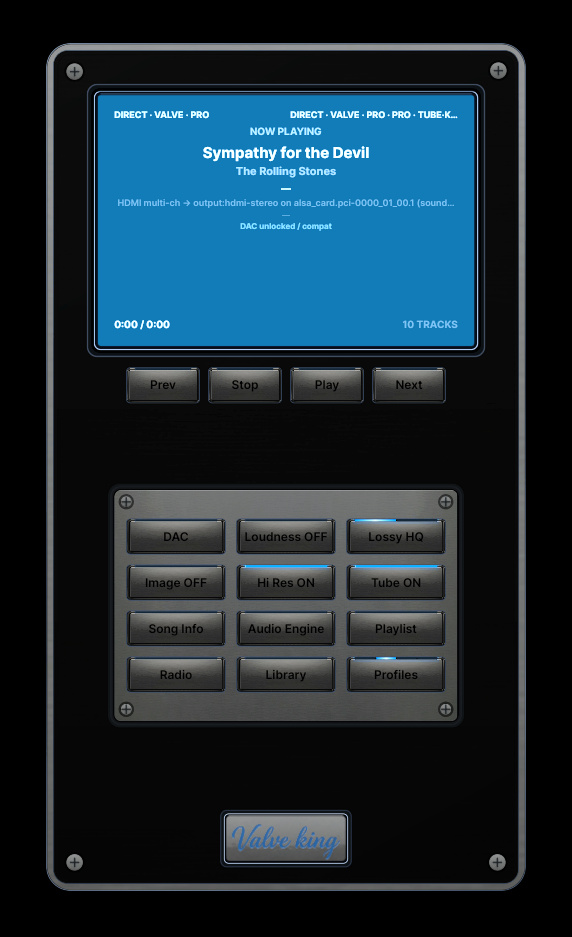
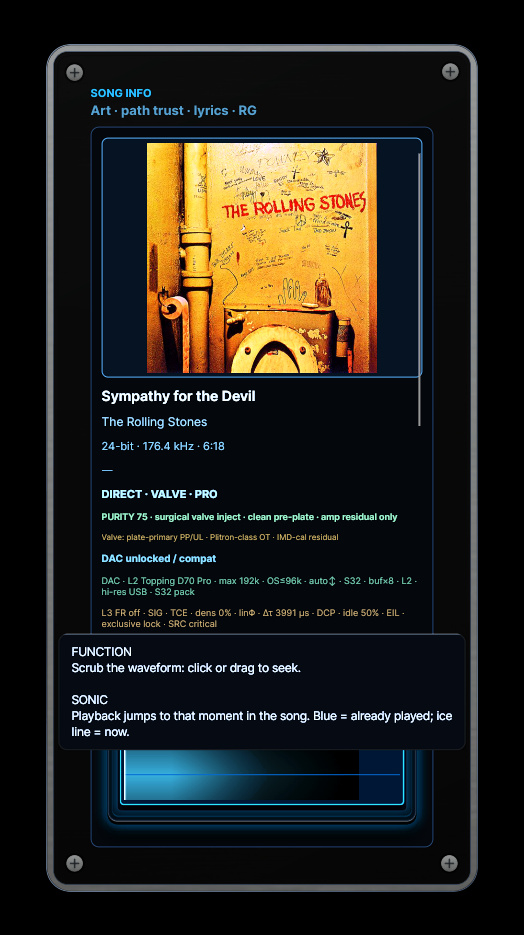
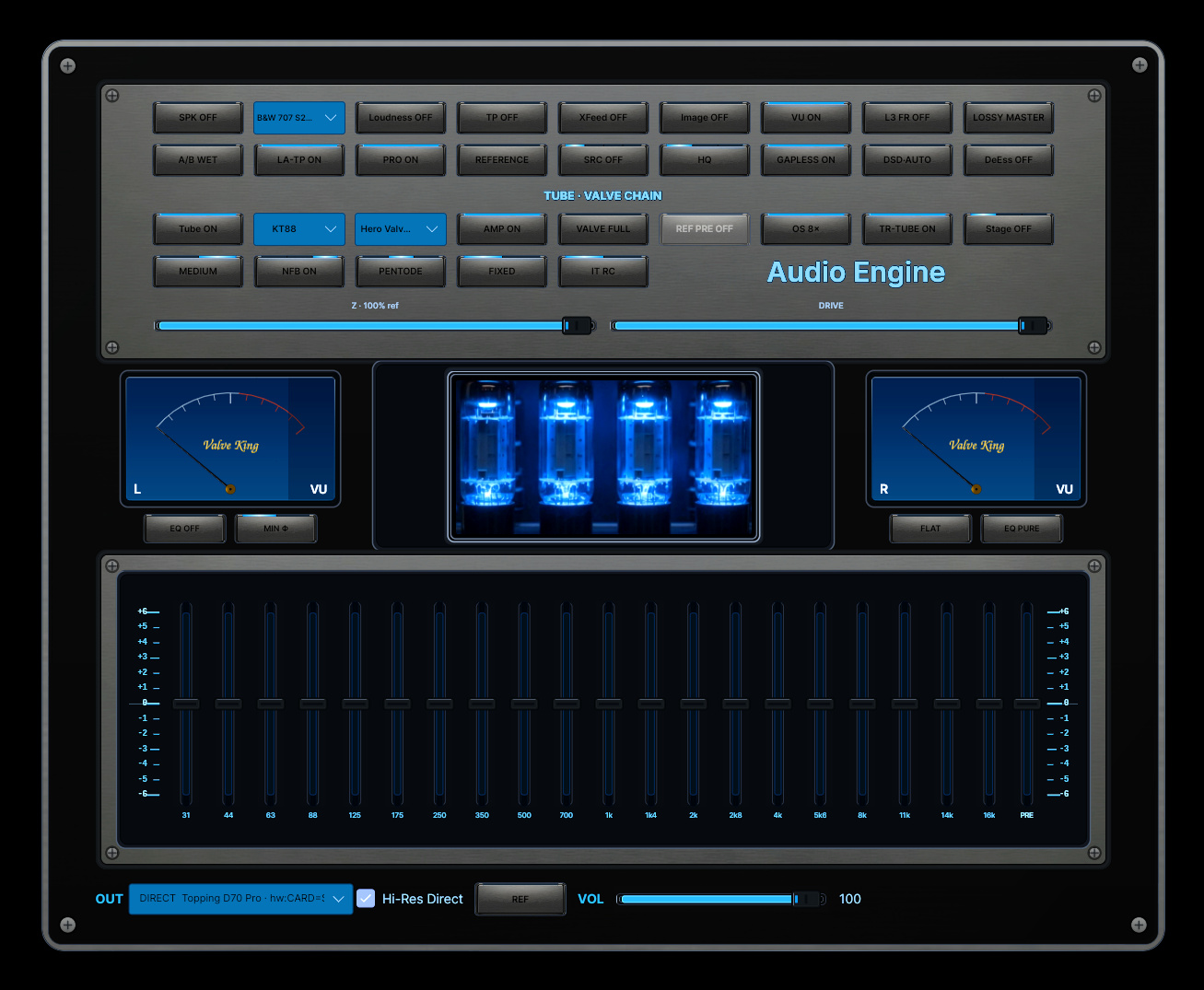
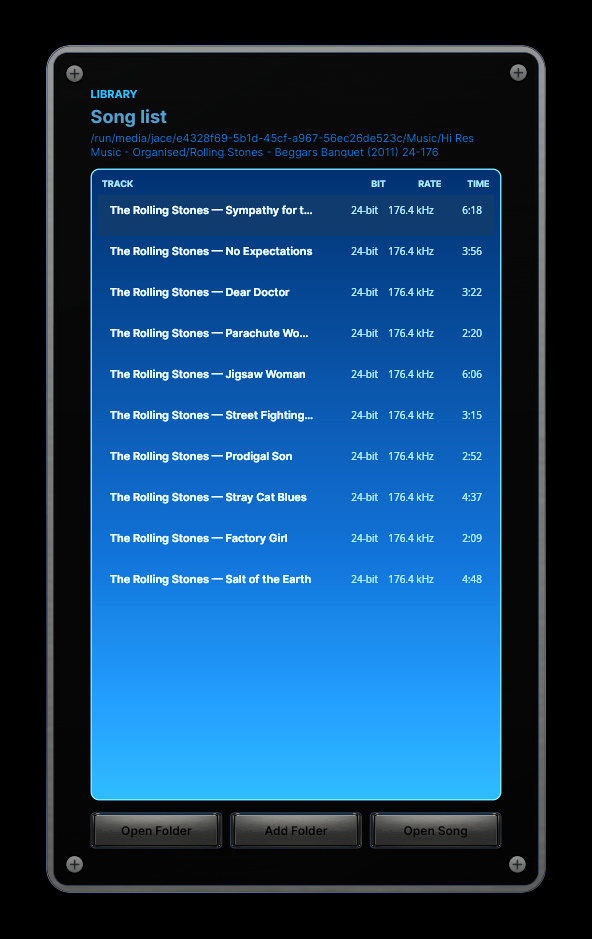
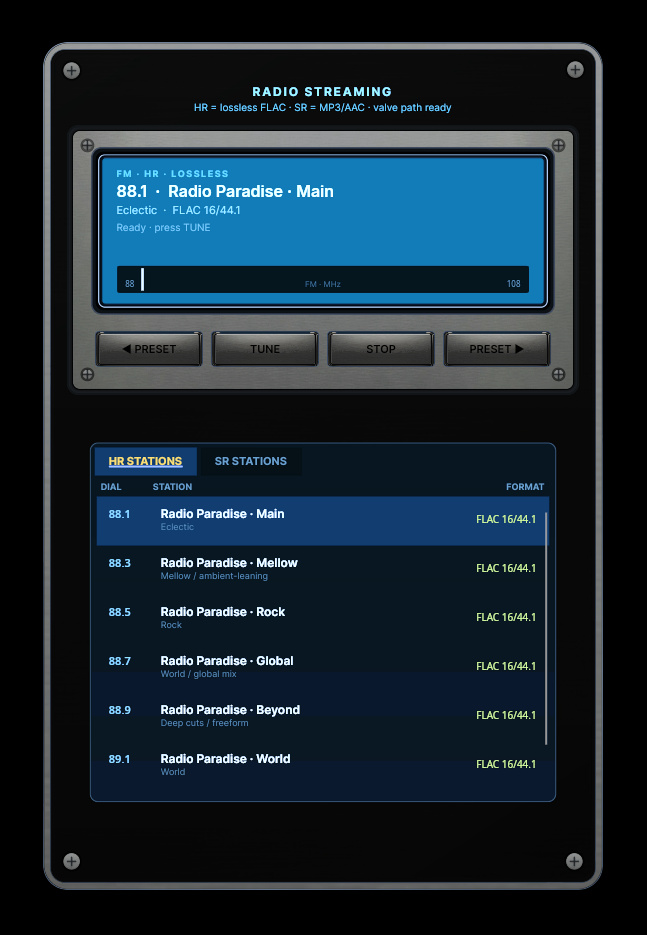
Purpose-built around how real glass and iron behave — not a plugin rack with a “tube” knob.
Amp packages are original topology-class models for listening, based on public datasheets and published circuit character. Not affiliated with, endorsed by, or clones of any named manufacturer.
Many players and “hi-res” modes sell sample-rate inflation as an upgrade: stretch a 44.1 kHz file to 96 or 192 kHz and call it better. Mathematically, that is interpolation — new sample points estimated between the old ones — not new musical information. Valve King’s lossless path and Glorious Lossy are built on a different idea: keep masters honest at their true rate, and repair the real damage of compression where it lives.
A digital audio file is a sequence of samples at a fixed rate. The highest frequency that sequence can represent is half that rate (the Nyquist limit) — about 22 kHz for CD-rate PCM. Upsampling (sample-rate conversion upward) inserts extra samples through a reconstruction / interpolation filter, then re-samples the continuous-looking waveform at a higher clock. The spectrum below the original Nyquist can be preserved with a high-quality converter; everything above the original bandwidth is either empty, filter stop-band leftovers, or imaging/ringing artefacts from the converter — not recovered studio detail.
Upsampling can be a legitimate engineering tool (match a fixed device rate, feed a specific DSP block, avoid a bad OS resampler). It is a weak lever for sonics: it does not put back what a perceptual codec threw away, and it can smear the attacks rock ’n’ roll lives on.
On FLAC, WAV, AIFF, ALAC, WavPack and true hi-res, Valve King prefers an
integer pure path: decode close to the file’s native PCM,
keep processing off unless you ask for colour, and open the converter at the
exact sample rate of the file on ALSA Direct (hw:, exact negotiation)
on Linux; Windows (coming soon) uses ASIO (and WASAPI exclusive) with the same exact-rate discipline.
If the device cannot do that rate, Direct fails honestly instead of silently resampling —
the opposite of a “stretch everything to 96 kHz” soft mixer.
At unity volume with valves, EQ, and SRC off, that path is designed for bit-perfect delivery of the master as stored. Your DAC then runs its reconstruction filter on the rate the music was actually authored at — 44.1, 48, 96, 192 kHz as the file says — not on a player-invented clock. Optional valve packages sit on top as a physics-led choice; they do not smuggle lossy polish into a studio file, and they do not rebrand upsampling as purity.
Perceptual codecs (MP3, AAC, Opus, Vorbis) discard energy under masking thresholds, smear pre-echo around sharp attacks, collapse stereo into joint coding, and leave grainy or sealed-in tops. None of that is cured by writing more zeros between samples. Glorious Lossy runs in the float path after a true lossy decode, only when hard gates confirm a compressed source, and targets those mechanisms in the room:
That is listening recovery on the domain where the information was lost — psychoacoustic time/frequency behaviour — not a claim that a compressed stream becomes a bit-perfect master, and not empty bandwidth sold as detail.
Lossless engine: protect the master — native rate, exclusive path when the kit allows, optional valves as colour, no silent SRC, no “sauce” on studio files. Glorious Lossy: help compressed libraries and radio breathe by addressing codec artefacts in real time, hard-quarantined so FLAC and friends never enter that path. Upsampling remains available as a technical necessity when hardware demands a fixed rate; it is not marketed here as the primary way to make music sound more alive.
MP3, AAC, Opus, and other compressed sources throw away information to save space. Glorious Lossy is a listening recovery path — not a claim to recreate the studio master. It works in real time on playback, only on true lossy sources, and never rewrites files on disk. What follows is how the stages feel in the room, not a lab paper.
Compression often leaves music sounding boxed-in: brittle tops, thin mids, a centre image that swims, and a stereo field that feels crushed. Glorious Lossy is a stack of purpose-built stages that ease those symptoms so compressed tracks feel more whole and listenable for hours — without pretending a 320 kbps stream is bit-perfect tape.
Lossy codecs often shut the top end down or leave a harsh grain. This stage restores a sense of air and extension so cymbals and room tone feel less sealed-in, while softening the brittle digital edge that makes long sessions tiring.
Bit-starved files go thin in the lower midrange — vocals and guitars lose chest. Body recovery brings back weight and density so rock ’n’ roll has punch again, without a muddy bass shelf that masks the mix.
On weak encodes, the centre drifts and the stage collapses. Stereo / mid-side style restore firms the vocal centre and opens width and depth cues so the image feels more holographic — instruments have a place, not a flat wall of sound.
Presence work keeps lead vocals and lead instruments from disappearing into the hash. You hear diction and attack more clearly, without the shouty “radio loudness” boost that fatiguing enhance buttons often add.
Compression smears drum hits and pick attacks (pre-echo and soft transients). Clarity / transient stages help snaps and plucks speak again so rhythm sections stay lively, without turning every track into a clicky demo.
Modern masters and lossy streams can spit harsh energy up high. De-harsh eases that grain and sizzle when it is present — adaptive, not a permanent dulling filter — so loud choruses stay listenable without killing air entirely.
Recovery aims for controlled low end: firmer kick and bass lines that start and stop, rather than a one-note boom. Paired with body in the mid-bass, rock mixes keep drive without mud.
Soft limiting / ceiling behaviour on float paths keeps peaks from spitting, so compressed playlists and radio feel calmer under load. The goal is music you can live with for an evening — not a short demo blast.
Glorious Lossy arms only when the decoder labels the source as compressed (MP3, AAC/M4A, Opus, Vorbis, lossy radio). Lossless and hi-res stay on the clean codec path — optional valves and EQ are separate choices. After the 14-day trial ends, lossy formats continue to play; a full license unlocks the complete engine set.
Native / DoP where the device allows; clean PCM when that is right for your converter.
Critical listening. Integrity first.
Physics engine colour on exclusive path.
Full recovery for compressed libraries.
Background play, lighter load.
£79.99 one-time limited-time offer (full price £129.99) — same on Linux (now) and Windows (when shipped). Lifetime license for one PC only. Try free for 14 days on Linux; lossy formats continue after trial.
Hear Pure, Valve, and Glorious Lossy on your own DAC. After day 14, lossy formats continue to play.
After download: unzip →
chmod +x RenniLink-Valve-King-Trial-linux-x64.run →
./RenniLink-Valve-King-Trial-linux-x64.run
Includes: 14-day trial · Activate with email + PC ID-locked serial (VK1.…)
Direct link:
Download zip
· questions:
Contact sales
Introductory price £79.99 (time-limited). Full price will be £129.99. Same offer on Linux (now) and Windows (when shipped). Pay securely with PayPal, then send your receipt + PC ID for a serial locked to that computer only.
PayPal checkout · after payment use Contact sales with purchase ID + PC ID
Refund policy: digital licence sales are final once a serial key has been issued for your PC ID. Before issue, contact us if you paid in error. After issue, all sales are final and non-refundable.
Your serial is locked to one computer. You will send us a PC ID from the app so we can issue a key that only works on that machine.
chmod +x RenniLink-Valve-King-Trial-linux-x64.run
→ ./RenniLink-Valve-King-Trial-linux-x64.run
RVK-A1B2-C3D4-…). Keep this — the serial is bound to it.
RVK-…)VK1.…) → full Valve King unlocks on that PC only.
It will not activate on any other computer.
Once your serial key has been issued, the sale is final and non-refundable (digital goods bound to your PC ID). Need help? Contact sales · New PC later? Buy a new 1-PC license (or contact us with the new PC ID if we offer a transfer).
If you want a high-fidelity audio and music player on Linux with a true exclusive DAC path (ALSA Direct), physics-led valve colour, and a ground-up codec engine — not another soft-mixer front end — Valve King is built exactly for that. Download the free 14-day trial and judge it on your own DAC and library.
Pay £79.99 with PayPal (limited-time; full price £129.99), then use Contact sales with your purchase ID, the email for the license, and your PC ID from Activate. See How to purchase and activate. Once a key has been issued, all sales are final.
No. When a serial key has been issued for your PC ID, the sale is final and non-refundable. You may contact us before a key is issued if you paid in error.
£79.99 is a limited-time introductory price for the lifetime 1-PC license. The full price will be £129.99. Same limited-time offer on Linux (now) and Windows (when shipped).
Lossy formats continue to play. A lifetime serial unlocks the full product (valves, EQ, library, hi-res).
Yes. The serial is signed for your PC ID. It will not activate on another computer. A new PC needs a new license.
No. Real-time on playback only. Turn valves off for the clean path.
No. Inflating sample rate only interpolates; it does not restore bits a codec discarded or make a master “more hi-res.” The lossless engine keeps native rates and an exclusive Direct path for honesty; Glorious Lossy repairs compression artefacts on true lossy sources only. See Beyond upsampling.
No. One-time lifetime license (currently £79.99 limited-time; full price £129.99). Offline listening is first-class.
Coming soon. Linux is available now with a public trial download. Windows will use ASIO for exclusive exact-rate playback to your interface / DAC, with WASAPI exclusive as an alternate path — same product engines as Linux. See platforms.
No. Same limited-time £79.99 (full price £129.99) lifetime · 1 PC on both platforms. A license for one OS machine does not auto-unlock the other OS.
Warmth. Harmonics. The feel of the analogue era — with modern exclusive playback, honest paths, and engines that respect your masters. Put your converter in charge. Keep purity when you need it. Let the valves bloom when you don’t.